

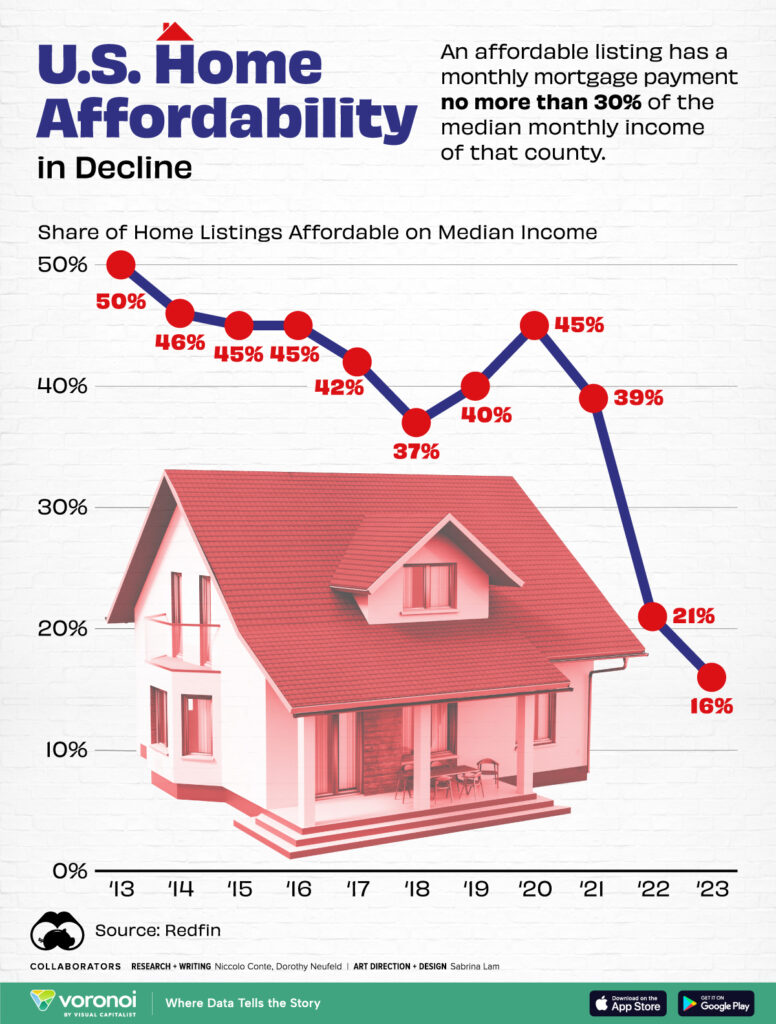
Across America, the dream of owning or even renting an affordable home is slipping away for millions of people. Whether it’s renters in crowded cities or homeowners in small towns, the burden of housing costs cuts across geography, class, and political lines. The challenges of affordability, zoning, and supply are national in scope, and they demand cooperation rather than polarization.
The Scale of the Problem
The U.S. housing shortage is well documented. When supply fails to keep pace with population growth and job creation, prices inevitably rise. That pressure affects renters first, but it also limits the ability of young families to buy homes and increases property taxes for long-time owners.
Research consistently shows that overly restrictive land-use rules make housing more expensive. A 2023 study found that a one-standard-deviation increase in regulatory stringency was associated with nearly a one percent increase in the share of cost-burdened renters—those spending more than 30 percent of their income on housing. Those higher costs were also linked to slower job growth in local economies.
The Urban Institute, working with the Bipartisan Policy Center, found that relaxing zoning restrictions increased housing supply by roughly 0.8 percent over the medium term, typically between three and nine years. While modest, that increase can have a stabilizing effect on prices when scaled nationally.
These findings suggest a clear pattern: when regulation constrains new construction, affordability suffers. The question is not whether government should act, but how to create policies that balance local input with the national need for more homes.
Why This Isn’t a Left or Right Issue
Housing has been caught in a tug-of-war between ideological extremes. One side focuses on subsidies and rent controls, while the other insists that the free market alone will correct shortages. In reality, both approaches miss the larger point.
When housing costs climb, both parties’ constituents suffer. Renters in Democratic-led cities face the same pressures as working families in conservative suburbs. Likewise, small business owners and teachers in rural counties experience the same barriers to homeownership as professionals in urban centers.
Recent state-level reforms demonstrate that bipartisan cooperation is possible. According to the Pew Research Center, several states—including Texas, Arizona, and Washington—passed housing packages in 2025 with broad cross-party support. These measures allow apartments in commercial zones, reduce minimum lot sizes, and speed up permitting timelines. The unifying goal was to increase the housing supply, not score partisan victories.
As one policy writer put it, “States across the country are dismantling outdated zoning rules and encouraging denser development. From Connecticut to Montana, legislators are advancing reforms that put homes over headlines.”
The lesson is straightforward: effective housing policy isn’t about left or right. It’s about results.
Supply-Side Solutions That Work
Experts across the political spectrum increasingly agree that the best way to address housing affordability is to build more housing. The key supply-side reforms include:
- Zoning Modernization: Allowing duplexes, townhomes, and small apartment buildings in areas previously zoned for single-family homes. Oregon’s 2019 law is an example, enabling “missing middle” housing types in larger cities.
- Reducing Parking and Lot-Size Mandates: These requirements add substantial cost to each unit built. Removing them allows more efficient and affordable design.
- Streamlining Permitting: Simplifying the approval process helps builders respond to demand faster and reduces costs associated with delays.
- Building Near Jobs and Transit: Locating housing near employment centers and public transportation reduces commuting costs and maximizes infrastructure investment.
- Encouraging Adaptive Reuse: Converting unused commercial buildings into housing can revitalize downtown areas and reduce construction waste.
These ideas are not partisan. They simply address the fundamental mismatch between the number of homes Americans need and the number available.
Bridging the Urban-Rural Divide
While the symptoms of the housing crisis differ between rural and urban areas, the root causes are connected. Urban markets suffer from scarcity and high demand, while many rural regions face aging housing stock and a lack of investment.
A balanced national housing strategy would promote both renovation and new construction. For rural areas, that could mean tax incentives for home repairs and conversions of vacant properties. In urban areas, it might involve zoning reform and infrastructure funding to accommodate population growth.
The Bipartisan Policy Center notes that zoning reform alone isn’t enough without financing mechanisms and state-local coordination. Affordable housing requires consistent collaboration among governments, developers, and communities.
The Case for Centrist Governance
Pragmatic, centrist leadership is crucial in housing policy because the issue touches so many others—economic development, environmental impact, and community stability. When politics tilts toward the extremes, either side tends to overcorrect. Heavy-handed mandates can alienate local voters, while laissez-faire inaction leaves markets unstable.
The centrist approach values durability. Bipartisan legislation tends to last longer because it reflects consensus. Housing policy works best when it prioritizes function over ideology. That means:
- Building coalitions that include both parties and local stakeholders.
- Measuring success by outcomes—more homes built, fewer cost-burdened families—rather than political wins.
- Maintaining accountability through transparency and data, not rhetoric.
- Recognizing that renters and homeowners share common interests: stable communities and fair costs.
As one national housing advocacy group put it, “This is not a partisan issue. It affects families in every state and every district.”
What Progress Could Look Like
If widely adopted, bipartisan supply-side reforms could gradually improve affordability. Even small increases in housing stock help stabilize markets and give families more options. Over time, greater availability could also strengthen the economy by enabling mobility, job growth, and household formation.
Yet challenges remain. Local opposition to new development can delay or block construction. Rising material and labor costs add further strain. Infrastructure—roads, schools, water systems—must expand alongside new housing. These realities require coordinated planning and realistic timelines.
Despite these barriers, momentum is building. Red and blue states alike are experimenting with similar solutions, learning from one another, and showing that cooperation still has a place in American governance.
A Path Forward
The housing crisis is not a culture war issue. It is an economic and civic one that touches nearly every American household. Solutions will not come from slogans or single-party agendas, but from shared recognition of the problem’s scale and complexity.
By focusing on supply, zoning reform, and efficient permitting, policymakers can make meaningful progress without relitigating ideological battles. By aligning local control with state-level vision, governments can maintain community input while meeting regional needs.
Housing affordability offers a test case for what centrist politics can achieve. When leaders choose collaboration over conflict, they create policies that last. The reward is not only more homes but renewed public faith that government can still work for everyone.
At its heart, the housing issue embodies the mission of Common Ground Politics: progress built on cooperation, results grounded in evidence, and a belief that the American dream belongs to all, regardless of party or zip code.